Key Takeaways
- Match washing capacity to production demand. A commercial bakery pan washer should handle peak cleaning volumes without slowing production.
- Consider pan types and residue characteristics. Bread tins, baking sheets, muffin trays, and specialty molds may require different cleaning approaches.
- Evaluate automated versus batch washing systems. The right configuration depends on throughput, available space, and how pans move through production.
- Prioritize cleaning consistency and food safety. Properly designed systems help remove food residues and support documented sanitation procedures.
- Account for operating costs. Labor, water, energy, chemical consumption, and maintenance all affect long-term equipment value.
- Plan for future production needs. Flexible washing equipment can help accommodate changes in bakery products, pan sizes, and production volume.
In high-volume commercial bakeries, keeping baking pans, tins, trays, and molds clean is essential to maintaining product quality, food safety, and production efficiency. When hundreds or thousands of baking items move through a facility each day, manual washing can quickly become a costly bottleneck.
An automated pan and tin washer can help commercial bakeries improve cleaning consistency, reduce manual labor, and keep reusable baking equipment ready for the next production cycle. However, selecting the right system requires more than comparing machine capacities and purchase prices.
The best industrial bakery washing equipment must accommodate the types of pans being cleaned, the volume of production, the residues being removed, and the facility’s available space and utilities.
Why High-Volume Bakeries Need Specialized Pan Washing Equipment
Commercial bakeries face cleaning challenges that differ from those of many other food processing operations.
Baking pans and tins are repeatedly exposed to high temperatures, oils, fats, sugars, dough residues, and baked-on deposits. These contaminants can accumulate on surfaces, corners, and edges, making consistent cleaning difficult.
Traditional manual cleaning methods can create several operational problems:
- Excessive labor hours spent soaking, scrubbing, and rinsing pans
- Inconsistent cleaning results between operators and shifts
- Delays when clean pans are unavailable for the next production cycle
- Increased wear on baking equipment from improper cleaning methods
- Higher water and chemical consumption from inefficient washing practices
- Potential food safety concerns when residues are not adequately removed
Automated industrial pan washers help standardize the cleaning process, reducing dependence on manual scrubbing while supporting more predictable production schedules.
For facilities operating multiple shifts or continuous production lines, this consistency can be particularly valuable.
1. Determine the Right Pan Washer Capacity for Your Bakery
One of the first considerations when selecting a bakery pan washing machine is throughput. A washer that cannot keep pace with production can create delays, even when the baking line itself is operating efficiently.
Calculate Your Actual Washing Requirements
Before evaluating equipment, determine:
- How many pans, tins, or trays require washing per hour?
- How many production shifts operate each day?
- Are pans washed after every use or at scheduled intervals?
- What is the highest cleaning volume during peak production?
- How much time is available before clean pans must return to production?
For example, a bakery producing 3,000 pans per hour may require a washing system capable of processing that volume, depending on its cleaning schedule and available pan inventory.
However, a machine’s advertised capacity should not be the only consideration. Actual throughput depends on pan dimensions, loading orientation, spacing, soil conditions, and required cleaning time.
The goal is to select a washer based on verified cleaning capacity under realistic operating conditions, not simply its maximum rated throughput.
2. Match the Washing System to Your Pan and Tin Types
Not all bakery equipment presents the same cleaning challenges. A commercial bakery may use several types of reusable equipment, including:
- Bread tins and loaf pans
- Baking sheets and flat trays
- Muffin and cupcake trays
- Cake molds and specialty baking tins
- Multi-cavity baking pans
- Perforated baking trays
Differences in size, geometry, material, and surface coatings can affect cleaning performance.
Consider Difficult-to-Clean Surfaces
Deep cavities, folded edges, corners, and perforations may trap residues that are difficult to remove through simple rinsing. A suitable industrial pan washer should provide effective wash coverage across these surfaces without damaging the equipment.
The cleaning process must also be compatible with pan materials and finishes. Some nonstick coatings, for example, may require specific detergents, temperatures, or mechanical handling practices to prevent premature deterioration.
When comparing systems, ask whether the manufacturer can evaluate representative pans using the bakery’s actual residues and cleaning requirements.
3. Compare Continuous and Batch Pan Washing Systems
The appropriate washing configuration depends largely on production volume and workflow.
Continuous Conveyor Pan Washers
Continuous conveyor washing systems are generally well suited to high-volume bakery operations where pans move through production in a predictable sequence.
Pans travel through the washer on a conveyor, passing through designated cleaning stages that may include washing, rinsing, and drying.
Potential advantages include:
- Continuous processing of large pan volumes
- Consistent cleaning conditions
- Reduced manual handling
- Integration with existing production workflows
- Predictable output of cleaned equipment
For bakeries operating high-speed production lines, conveyor-based systems may offer an efficient way to keep washing operations synchronized with production.
Batch Washing Systems
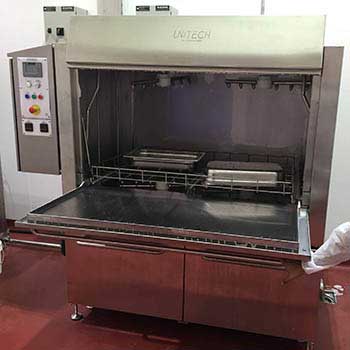
Batch washers process a defined quantity of pans or trays during each cleaning cycle. They may be appropriate for facilities with lower volumes, frequent product changes, or a wide variety of equipment requiring different cleaning procedures.
Batch systems can offer flexibility but may require more loading and unloading activity.
| Consideration | Continuous Conveyor Washer | Batch Washer |
|---|---|---|
| Production volume | High, consistent throughput | Variable or moderate volumes |
| Workflow | Continuous movement | Individual cleaning cycles |
| Pan variety | Best with compatible handling arrangements | Often suitable for varied items |
| Automation | Potential for production-line integration | Typically more operator involvement |
| Space | May require a longer footprint | Often more compact |
The final choice should reflect actual production conditions rather than throughput alone.
4. Evaluate Cleaning Performance and Food Safety Requirements
Effective bakery sanitation requires more than making pans look clean. Food residues, oils, allergens, and other contaminants must be controlled according to the facility’s documented food safety procedures.
When evaluating an automated bakery pan washer, consider the following performance factors.
Water Temperature and Spray Coverage
Water temperature, spray pressure, nozzle placement, and cleaning chemistry work together to remove residues.
The appropriate settings depend on the type of contamination and the materials being washed. More pressure or higher temperatures do not automatically produce better results.
Detergent Compatibility
Cleaning chemicals should be suitable for the residues being removed and compatible with the pans, washer components, and applicable food-contact cleaning procedures.
Rinsing and Drying
Thorough rinsing helps remove loosened residues and cleaning chemicals. Where required, drying reduces residual moisture before equipment returns to storage or production.
Cleaning Validation
Food manufacturers should establish measurable cleanliness requirements and verify that the washing process consistently meets them. Depending on the application, verification may include visual inspections, residue testing, allergen swabs, or microbiological testing.
An automated washer can support a facility’s food safety program, but compliance depends on validated procedures, appropriate operation, and ongoing monitoring.
5. Consider Labor Savings, Water Usage, and Operating Costs
The purchase price of an industrial pan washer represents only one part of the investment.
A complete evaluation should consider the total cost of ownership, including:
- Equipment purchase and installation
- Operator labor requirements
- Water and wastewater costs
- Energy consumption
- Detergent and chemical usage
- Routine maintenance and replacement parts
- Production downtime associated with cleaning
How Automation Can Improve Efficiency
Automated washing can reduce repetitive manual cleaning tasks and allow sanitation personnel to focus on inspection, monitoring, and other essential responsibilities.
Depending on the equipment configuration, features such as controlled wash cycles, water recirculation, and optimized spray systems may also help reduce resource consumption. These savings should be evaluated using actual facility operating data rather than assumed percentages.
A useful return-on-investment calculation compares annual operating costs before and after automation, including any measurable improvements in throughput and labor utilization.
6. Plan for Installation, Maintenance, and Future Growth
Even a highly effective washing machine can become a problem if it does not fit the facility’s operational requirements.
Before purchasing, review the proposed installation with production, sanitation, engineering, and maintenance personnel.
Important questions include:
- Is sufficient floor space available for the washer and material handling?
- Can the facility provide the required water, drainage, electrical, and heating utilities?
- How will dirty pans enter the system and clean pans return to production?
- Are internal components accessible for inspection and maintenance?
- What operator training will be required?
- How quickly can replacement parts and technical support be obtained?
- Can the system accommodate additional pan sizes or increased production volume?
Maintenance accessibility deserves particular attention. Systems that are difficult to inspect or clean may increase downtime and complicate sanitation procedures.
Planning for future growth can also help prevent premature equipment replacement as bakery production requirements change.
Choosing Industrial Bakery Washing Equipment with Sanicore Systems
Selecting the right pan and tin washer requires a clear understanding of production volume, equipment geometry, cleaning requirements, and operational priorities. Sanicore Systems helps food processing facilities evaluate industrial washing solutions designed to support efficient, repeatable cleaning processes.
Our industrial washing equipment solutions can be evaluated for applications involving bakery trays, pans, tins, and other reusable food production equipment. We work with customers to identify appropriate washing configurations based on the items being cleaned, required throughput, available floor space, and sanitation objectives.
Whether your facility is replacing an aging washer, reducing manual cleaning, or planning a higher-capacity production line, choosing the correct equipment begins with a detailed assessment of your process.
Find the Right Pan and Tin Washing Solution for Your Bakery
The right industrial pan washer should do more than clean baking equipment. It should support reliable production, consistent sanitation, efficient resource use, and long-term operational performance.
If your bakery is evaluating automated pan and tin washing equipment, contact the Sanicore Systems team to discuss your production requirements. We can help you explore industrial washing solutions suited to your facility’s cleaning challenges and operational goals.