Key Takeaways
- Manual tote washing has a lower initial equipment cost but can require significant recurring labor as volumes increase.
- Automated bin and tote washing equipment can deliver more consistent, repeatable cleaning cycles while reducing dependence on manual labor.
- Throughput is an important consideration because manual cleaning capacity is closely tied to staffing levels and available sanitation time.
- Automation can improve process control by standardizing factors such as wash time, water application, temperature, and chemical use.
- Tote washer ROI should consider labor, water and chemical use, production bottlenecks, rework, maintenance, and long-term capacity needs.
- The right approach depends on tote volume, soil load, sanitation requirements, facility layout, available utilities, and future production plans.
For food processing facilities that rely on reusable totes and bins, washing is more than a housekeeping task. It is a recurring sanitation process that can affect labor requirements, production flow, food safety, and operating costs.
Manual washing may be practical when volumes are low or cleaning requirements are relatively simple. But as production grows, the same process can become a sanitation bottleneck. Comparing automated vs manual tote washing requires looking beyond equipment purchase price to understand the full impact on cost, compliance, consistency, and throughput.
What Is the Difference Between Automated vs Manual Tote Washing?
Manual tote washing typically relies on employees using hoses, pressure washers, brushes, chemicals, and other cleaning tools to remove product residue and contaminants. Depending on the facility, totes may be cleaned individually or in batches.
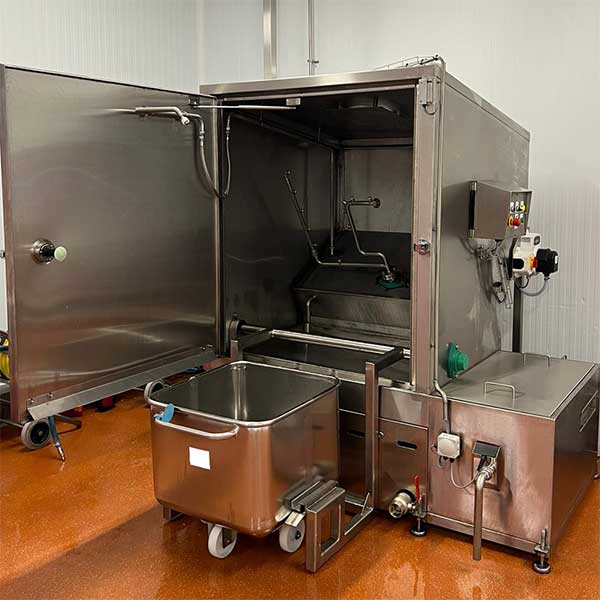
Automated tote washing equipment moves much of that process into purpose-built equipment. Totes or bins are loaded into the system and subjected to controlled washing and, depending on the configuration, rinsing, sanitizing, and drying stages.
The most important distinction is repeatability.
Manual washing depends heavily on individual technique, available time, staffing, and adherence to procedures. Automated systems are designed to apply established cleaning parameters repeatedly from one cycle to the next.
Cost: Is Manual Tote Washing Really Less Expensive?
Manual cleaning usually wins the initial-cost comparison. A facility does not need to make a significant capital investment in washing equipment, which can make manual cleaning appear economical. The calculation changes when recurring expenses are considered.
Manual tote washing can involve:
- Sanitation labor hours
- Overtime or additional shifts
- Water consumption
- Cleaning chemicals
- PPE and cleaning supplies
- Employee training
- Rewashing improperly cleaned totes
- Time spent supervising and documenting sanitation procedures
- Production delays when clean containers are not available
The cost of automation is more visible because equipment requires an upfront investment. However, an automated system may reduce several recurring costs simultaneously. That’s why a meaningful tote washer ROI analysis should compare total operating costs rather than simply comparing the cost of equipment with the cost of a hose and sanitation station.
Labor: How Does Tote Washing Automation Affect Staffing?
Labor is often one of the biggest variables in the manual-versus-automated calculation. If one employee can manually clean the number of totes a facility needs each day without delaying production, automation may be difficult to justify strictly on labor savings.
The equation can change considerably when hundreds or thousands of reusable containers must be cleaned regularly.
Manual washing capacity increases primarily by adding people, hours, or cleaning stations. Automated equipment provides another way to increase capacity without requiring sanitation labor to grow at the same rate.
Automation does not necessarily eliminate the need for employees. Operators may still load and unload equipment, inspect cleaned items, monitor the system, and perform routine maintenance. However, employees can often be redirected from repetitive manual washing toward inspection, sanitation verification, production support, and other higher-value tasks.
Automation can also reduce some of the physical demands associated with repetitive scrubbing, prolonged hose use, wet environments, and chemical handling.
Compliance: Which Approach Provides More Consistent Cleaning?
A written sanitation procedure may specify exactly how a tote should be cleaned, but manual execution can vary. One employee may scrub longer than another. Water temperature can fluctuate. Chemical concentration may change. Difficult surfaces can receive different levels of attention depending on workload and available time.
These variables become increasingly important when facilities need repeatable sanitation procedures and documentation to support their food safety programs.
Automated bin and tote washing equipment can provide greater process consistency because cleaning parameters are established by the system rather than recreated manually for every container.
Depending on the equipment and application, controlled parameters can include:
- Wash cycle duration
- Water temperature
- Spray coverage
- Chemical application
- Rinse stages
- Sanitizing processes
- Drying time
Automation by itself does not guarantee regulatory compliance. The washing process still needs to be appropriate for the product, soil type, container design, facility requirements, and applicable sanitation program. But greater process consistency can make sanitation procedures easier to control, validate, and document.
Throughput: When Does Manual Washing Become a Bottleneck?
Throughput is one of the clearest reasons to evaluate automation. A facility may be able to produce product faster than its sanitation team can clean the reusable containers needed to keep production moving. When that happens, tote washing stops being an isolated sanitation activity and becomes a production constraint.
Warning signs can include:
- Clean totes are frequently unavailable when production needs them
- Employees rush washing procedures to keep pace
- Sanitation overtime is increasing
- Additional workers are routinely assigned to container washing
- Production growth is limited by washing capacity
- Totes accumulate while waiting to be cleaned
- Cleaning increasingly extends into additional shifts
Automated washing systems are designed around defined throughput requirements. This allows a facility to evaluate washing capacity alongside production volume rather than treating cleaning as an unlimited manual resource.
How to Calculate Tote Washer ROI
There is no universal payback period for automated tote washing equipment. ROI depends on the facility, container volume, current labor requirements, system configuration, and operating schedule. A useful starting point is to document the current process.
Calculate annual manual washing costs, including labor, overtime, water, chemicals, supplies, rewash, and other measurable expenses. Then compare those costs with the projected operating costs of automated equipment.
Facilities should also consider costs that may be less obvious, including:
- Lost production time caused by unavailable clean totes
- Difficulty scaling sanitation labor as production grows
- Costs associated with inconsistent cleaning
- Employee turnover and training
- Additional sanitation shifts
- Future increases in container volume
The result provides a more realistic picture of tote washer ROI than purchase price alone.
When Does Automated Bin and Tote Washing Equipment Make Sense?
Automation tends to become more compelling when tote volumes are high, labor availability is challenging, cleaning consistency is difficult to maintain, or sanitation is beginning to constrain production.
Manual cleaning may remain appropriate for lower-volume operations, unusual containers, infrequently used items, or applications where automated equipment cannot be economically justified.
For many facilities, the decision is also not strictly manual or automated. An automated system may handle high-volume standardized totes while manual processes remain available for specialty items or exceptions.
The objective should be to match the cleaning method to the actual sanitation and production requirements.
Choosing the Right Tote Washing System
When automation makes sense, the next question is what type of system will fit the operation.
Sanicore Systems offers industrial bin and tote washing equipment designed for food processing environments and a range of reusable container sizes and applications. System selection can be based on factors including container dimensions, required throughput, contamination or soil type, available floor space, utilities, sanitation requirements, and integration with the facility’s workflow.
Rather than sizing a system around today’s volume alone, it is also useful to consider where production could be several years from now. The goal is to solve the current cleaning challenge without immediately creating the next capacity constraint.
If manual tote washing is consuming more labor, creating inconsistent results, or struggling to keep pace with production, it may be time to compare the economics of automation.
Contact the Sanicore Systems team to discuss your current tote washing process, throughput requirements, and sanitation goals. We can help evaluate whether automated bin and tote washing equipment makes sense for your facility and identify a system configuration suited to your application.